Rehab Medical Honors Adaptive Mobility Equipment Pioneers

In honor of National Inventors’ Month, we’re shedding light on the pioneers who paved the way for mobility freedom. In this article, we dive into inventors like Frank E. Fithen, who invented the first adaptive equipment; George J. Klein, who was the first to mass-produce the electric wheelchair; Allan R. Thieme, who invented the first mobility scooter; and Rory Cooper, who changed the way manual wheelchairs were self-propelled.

Frank E. Fithen Paves the Way for Adaptive Equipment

Often referred to as Ohio’s armless auto speed king, Frank Fithen had a love for living life in the fast lane. He would drive cars reaching speeds of up to 60 miles per hour, an unprecedented speed record during his time in the late 1800s. While his speed records turned heads, what made Fithen so enigmatic was he achieved these records as an armless driver.
At the age of 9, Fithen lost both arms in a railroad accident. He quickly learned how to live independently by using his mouth, feet, and assistive devices to help him perform daily activities. After mastering these tasks, Fithen went on to become a trick unicyclist and bicyclist, touring the nation with the Barnum and Bailey Circus.
Fithen’s love for adventure and the open road exposed him to the automobile world, where manufacturers solicited enthusiasts to test their vehicles in road races, endurance tests, and time trials. Quickly signing up to be an automobile tester, Fithen knew his lack of arms would prevent him from using conventional driving controls and decided to invent the first adaptive steering wheel.

He retrofitted standard steering wheels to include a series of rings within the rim of the wheel where he could fit the stumps of his arms into. He later added more rings, allowing him to steer with one limb and manipulate the gear shifts with the other limb.
Fithen set an early precedent for those with disabilities, showcasing that determination can help overcome any obstacles.

George J. Klein Develops the First Mass-Produced Electric Wheelchair
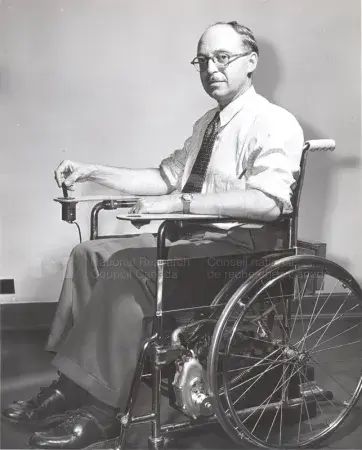
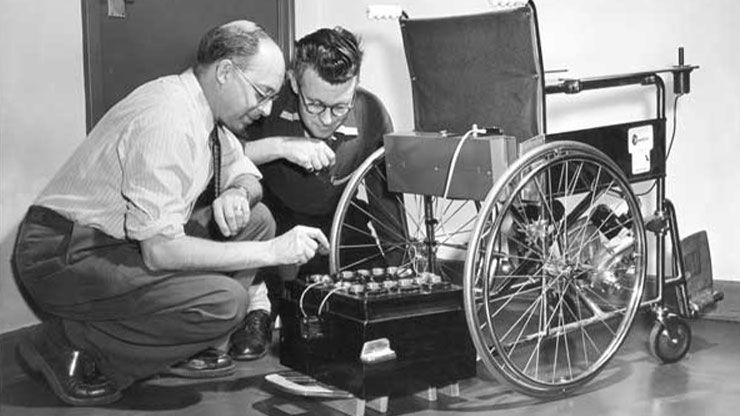
Often described as one of Canada’s most influential inventors, George J. Klein was driven by a lifelong desire to solve real‑world problems through mechanical ingenuity. After studying applied science and engineering at the University of Toronto, Klein joined the National Research Council of Canada (NRC), where he would work for the next forty years.
Known for his hands‑on approach, Klein collaborated closely with machinists, technicians, engineers, and end users, allowing ideas to move quickly from concept to prototype. His work spanned fields as diverse as aviation, nuclear engineering, and space exploration, but his most meaningful accomplishments were those that directly improved people’s lives.

In the aftermath of WWII, advances in medicine meant that many soldiers with spinal‑cord injuries survived, but traditional manual wheelchairs offered limited independence. Tasked by the Canadian government with improving early electric wheelchair designs, Klein set out to create a reliable, user‑centered solution.
Through years of testing and consultation with injured veterans, he developed the first practical, mass‑produced electric wheelchair, introducing features such as joystick controls and independent wheel drives that remain standard today.
Klein’s electric wheelchair transformed mobility for disabled veterans and civilians alike, setting a new global standard for assistive technology. Through this work, Klein set a lasting precedent for adaptive engineering, demonstrating how empathy, determination, and innovation can combine to remove barriers and restore independence.

Allan R. Thieme Invents the Nation's First Mobility Scooter

Often described as an inventor by necessity, Allan “Al” Thieme was a master plumber from Bridgeport, Michigan, living a busy life with his growing family. Everything changed when his wife was diagnosed with multiple sclerosis, a condition that slowly took away her ability to walk and made even simple daily tasks exhausting. While wheelchairs were widely available to the public by the mid-20th century, Thieme quickly realized that they didn’t offer the freedom or dignity his wife needed to stay active and engaged in everyday life.
Determined to help her remain independent, Thieme turned to what he knew best—hands‑on problem solving. With a rough sketch drawn on scrap paper and countless hours of tinkering in his garage, he began experimenting with motors, frames, and controls. What emerged was something entirely new: a small, electric, sit‑down vehicle designed to be stable, simple to operate, and comfortable for extended use. Thieme called his invention the Amigo, effectively creating the world’s first power‑operated mobility scooter.

Unlike traditional mobility devices, the Amigo allowed users to sit upright and move easily through stores, workplaces, and neighborhoods. For Thieme’s wife, it meant regaining the ability to shop, socialize, and care for her family. For others who saw the scooter in use, it represented a completely new approach to mobility—one focused on freedom rather than limitation.
Through perseverance and empathy, Allan Thieme set an enduring precedent for adaptive technology. His invention restored independence to thousands and laid the foundation for the modern mobility scooter industry, proving that determination and compassion can turn a simple garage project into a life‑changing innovation.

Rory Cooper Designs First Pushrim for Manual Wheelchairs
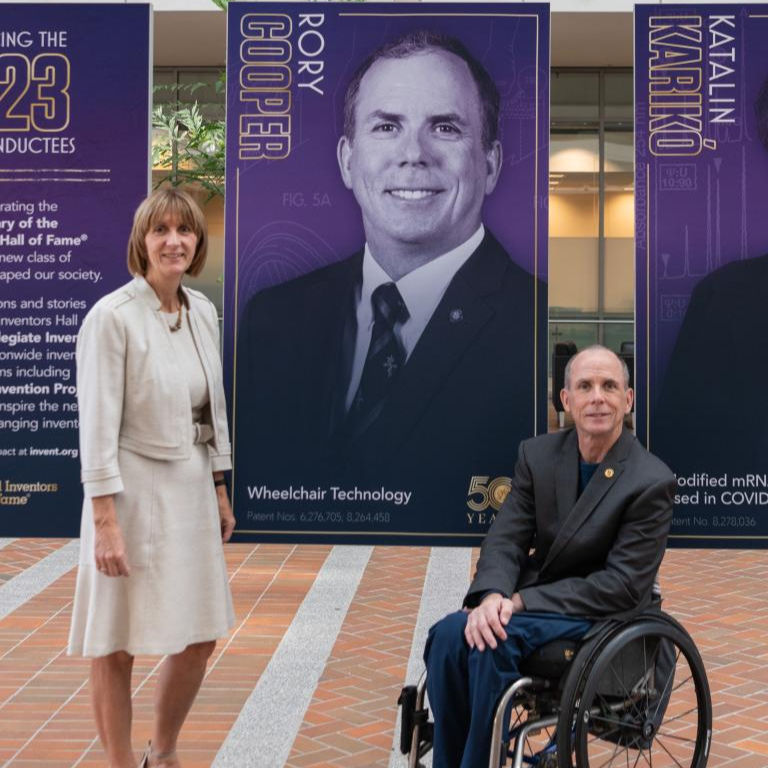
Often described as a pioneer of modern wheelchair technology, Rory A. Cooper built his life’s work around improving mobility, independence, and dignity for people with disabilities. While serving in the U.S. Army in 1980, Cooper’s life changed dramatically when he was struck by a bus while riding a bicycle in Germany, leaving him paralyzed from the waist down.
Having to now rely on a wheelchair, Cooper quickly discovered they were heavy and inefficient for the user. Rather than accept this, he began designing his own wheelchair to better suit his needs—marking the beginning of a career rooted in user‑driven innovation.

After Cooper founded the Human Engineering Research Laboratories (HERL) at the University of Pittsburgh in 1994, he worked in partnership with the U.S. Department of Veterans Affairs, as well as engineers, clinicians, therapists, and wheelchair users, to rethink mobility technology.
His research focused on movement, reducing injury, fatigue, and long‑term strain caused by poorly designed equipment. Cooper then engineered the first ergonomic dual‑surface wheelchair pushrim, designed to reduce stress on users’ hands, wrists, and shoulders while improving propulsion and braking. His invention was widely adopted by manufacturers and is now a standard feature used daily by hundreds of thousands of wheelchair users around the world.
Honoring the Foundation of Mobility Freedom
The adaptive mobility solutions we rely on today did not appear overnight—they are the result of vision, resilience, and personal determination from pioneers who refused to accept limitations as final. At Rehab Medical, we are proud to honor these trailblazers during National Inventors’ Month. Their work reminds us that mobility is more than movement; it is access, independence, and quality of life.
Resources
All images provided for the story are courtesy of the sources below. All include image credits to the original authors.


